Tell me why you picked the two artworks that you did.
I will say it was not easy to decide, because there are so many artworks I work with that I love. None of the material I work on is that well known so trying to figure out what constitutes “well known” versus “obscure” was difficult! The object I chose for my obscure piece is not obscure within the small group of scholars who work on this material, but it is not very well known outside of that group.
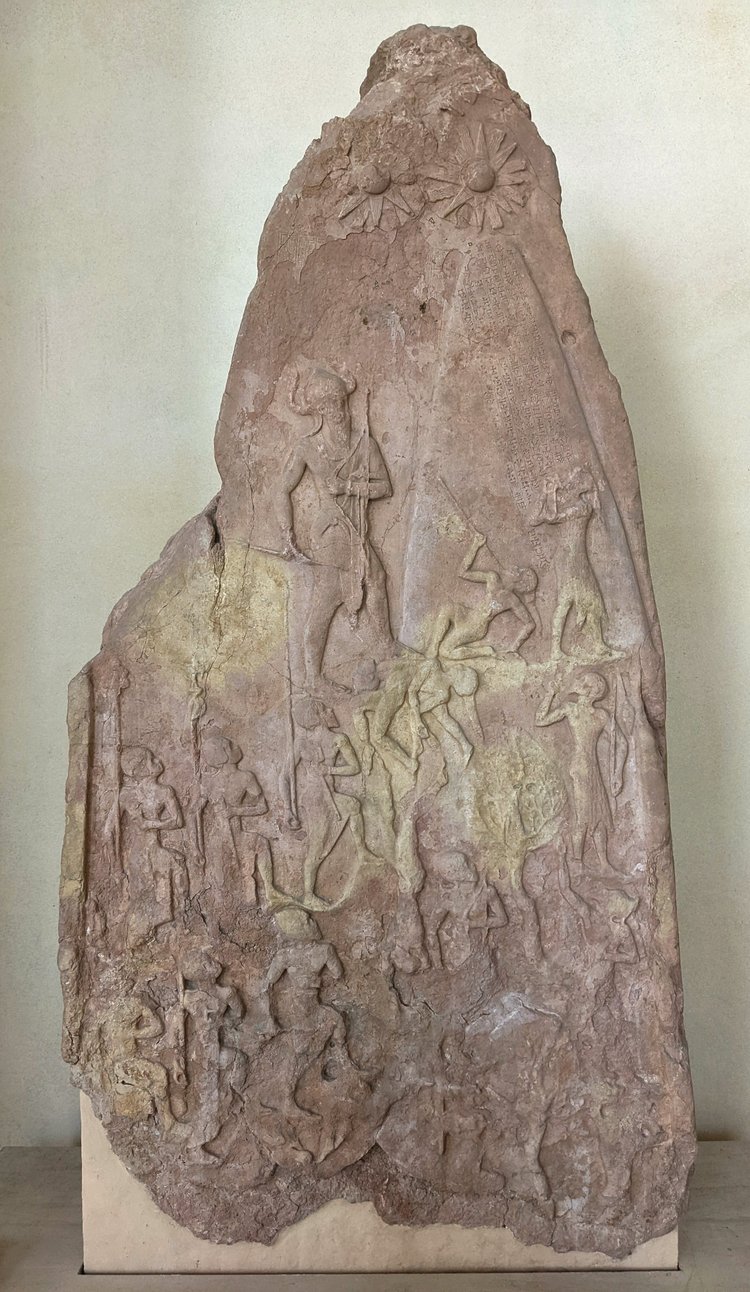
In picking my favorite well-known art piece I was torn between the Stele of Naram-Sin and the Code of Hammurabi, but I chose the Stele because it is a little bit more complex as an artpiece. There is more going on visually in it and it’s often held up as the great masterpiece of ancient Mesopotamian art.
In one of your articles you discuss how the Stele is often considered a breakthrough in terms of artistically conveying “spatial illusionism.” Can you expand on that?
The reason the Stele of Naram-Sin is often held up as a great masterpiece of Mesopotamian art is because it is a pretty striking break with the kind of monuments that preceded it. It comes out of a long tradition of large upright stones that are generally carved with a victory image of some sort. But previously the monuments had been done in registers, with scenes happening in separate bands and action moving left to right in a fairly straight-forward manner. But in the Naram-Sin Stele all of a sudden you have diagonal lines with Naram-Sin at the top and then his soldiers moving upward while the enemy are falling downwards. It creates a sort of triangular composition that hadn’t been seen before in Mesopotamian art.
It’s set on a mountainside and there’s a tree, so there is a sense of landscape and positioning within the space. I actually push against this in the work that I’ve done on this piece, because I think that it can be misleading when we try to transpose concepts from later art history onto this early material; the concept of landscape, the concept of naturalism doesn’t really apply for Mesopotamia. So, I’ve tried to think about why, instead of naturalism, would these radical artistic changes be made, and I think it has to do with the new social and political environment that the Akkadian dynasty is establishing for the first time by unifying all of southern Mesopotamia. It was the first time that all of these city-states were brought together under a single authority—the Akkadian king.
In the prior period, the so-called Early Dynastic period, the ideological rhetoric was that the ruler was the servant of the god. So each city had a patron deity and the ruler was simply the servant of that deity and was not ruling in his own right—that was the rhetoric. So when the first Akkadian ruler, Naram-Sin’s grandfather, Sargon, conquered all of the separate city-states and brought them all together, he needed to reshape this ideology. It seems to have taken a little while, but it really came to a fruition under Naram-Sin, when he deifies himself.
The horns on his helmet [depicted on the Stele] are the horns that signal divinity in Mesopotamian art. He deifies himself as the city god of his capital city of Agade. He is the god, as opposed to being the servant of the god. The other reason the Stele is often selected as a masterpiece is because of the voluptuousness of Naram-Sin’s body. I’ve suggested that this desire to focus on the physical world, his physical body, is because he has to invest these divine attributes in himself, in the human world. It’s the divine within the physical world.
It’s really interesting to hear how political and ideological changes can change art, and how imagery is conveyed.
And we can think about it from a slightly different vantage point, which is that it’s not just that the ideology is changing the art, but that the art is helping to form that ideology. When the king creates this image of himself as a deity, it helps that ideology take shape—to take a visual form.
Analysis of Mesopotamian art typically includes an analysis of the hierarchy being conveyed. Can you expand on the Stele’s portrayal of social hierarchy in comparison to the previous Mesopotamian monuments?
What’s interesting about the Stele is that, in many ways, it actually maintains the hierarchy that was before. Even though the registers are gone, Naram-Sin is still at the top. The soldiers are coming up on one side, and the enemy are falling down. So that hierarchy is still there. But the hierarchy that really changes is Naram-Sin’s relationship to the gods. There are no anthropomorphic gods except Naram-Sin himself, who is self-deified. There are these three celestial symbols at the top. There’s a lot of debate about the three stars/suns that are depicted in the sky. They look like they would be the sun, but there are three of them. They seem to be astral phenomena of some sort, where the divine is located. Previously, the divine had taken an anthropomorphic form, and so, there’s this concentration of the divine in the body of Naram-Sin and a distancing from the traditional gods.
In regard to the geopolitical context of the art piece, I was very interested to learn that the Stele is made out of a material sourced from the conquered area. Can you speak on how the material of the art piece itself helps us understand or analyze the artwork?
This monument was originally set up, as far as we know, based on the inscription, in a temple in the city of Sippar, in southern Mesopotamia. The temple is dedicated to the sun god. The Mesopotamian landscape is flat, and there are very few natural resources. There’s no wood, there’s no stone. It’s really a flat alluvial plain. A massive stone stele, and as it survives now, it’s about six feet tall, but it’s missing probably another foot or two feet from the bottom. So, this would have been a huge piece of stone in a place where they don’t have stone. It would have made a big impact just by the fact that it was stone.
The stone appears to have been taken from the location where this victory happened, which was in the Zagros Mountains to the east of Mesopotamia. And so you have a sort of depiction of that mountain on a piece of it. And the shape of the stone itself is mountain-like. So you have the physical appropriation of that land brought back to Mesopotamia and then set up in this temple complex.
You alluded to a missing part of the Stele. Can you tell me more about that?
We don’t really know that much about it. You can tell at the bottom that there are soldiers who are cut off. It seems as though there’s another set of soldiers below it that suggests we would have to add about 45 centimeters more at the bottom to put in another set of soldiers below that. So, it would have been quite big.
The afterlife of this monument is really interesting because it ends up being found in Susa in southwestern Iran, where it was taken around a thousand years later as booty. It was made around 2150 BCE, and it was taken as booty around 1150 BCE.
Is there any particular detail on the Stele that you are particularly interested in?
I want to point out the way in which he’s wearing a kilt, and there’s a knot that’s tied around his waist, and you can see the folds. We know that the kilt stretches downward, but you can’t see it. His body is completely visible through this garment, so it almost looks as if he’s naked. You get a real emphasis on the physical body, and this is very different from what was typical.
You’ve emphasized the fact that it might be misleading to impose our own, modern understanding of art and respect for realism onto the artist of this creation, but do you mind explaining to me what purpose making the body more realistic served in terms of conveying an ideological shift?
The way I see it is that the body and fabric textiles are working together in what I’ve called in my recent book, a “charisma of materiality.” The divine is exuding from him, so as a divine entity, he, as a physical being, has this aura. The earlier, more abstracted and geometric depictions of rulers can be thought of as the servants of the god. The previous ruler had power and authority coming from the god to him, but it was not from his own self, whereas here, the body of the king is in fact the divine and the holder of that power and that aura. And so there’s a concentration on the body and the fabrics that enfold the body.
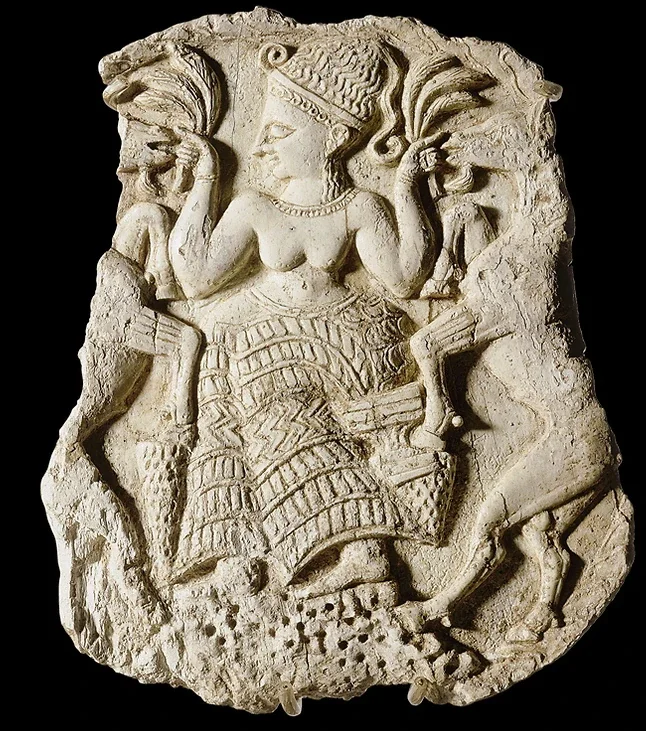
Can you tell me about your chosen obscure work, the carved ivory pyxis lid with Mistress of Animals from Ugarit?
This object is kind of radically opposite from the Naram-Sin Stele, which is part of why I liked thinking about the two together. This was an object that I had initially worked on as a graduate student, and my dissertation later became a book about international diplomacy and artistic exchanges in the Late Bronze Age (1600-1200 BCE). I’ve recently come back to this piece and I’ve been looking at it with slightly different eyes. And I think this is one of the wonderful aspects about art history is that you can return to an object and see it differently just by asking different questions or having different things on your mind.
The reason this object is usually celebrated is because it was found in the port city of a city-state, a kingdom on the Mediterranean coast of Syria. But the imagery on it looks very much like imagery from Minoan Crete in the Aegean. It’s always been held up as an exemplar of international exchanges that were happening during this period in which we see a lot of artistic borrowing and sharing of ideas. So that’s why I was looking at it at first. But now I’ve come back to it with fresh eyes, and I’ve been thinking about it instead in terms of its appearance in a family tomb.
It’s a circular lid that would have fit on the top of a container, a circular container. The lid and the container were made of elephant ivory. The container would have been a part of the tusk that was cut cross section and had a hollow in it. There was a container that was found in this tomb that we think belonged to the lid, but it’s very badly damaged and the imagery is almost impossible to see. So, in contrast to the Naram-Sin-Steele, a big royal monument, this is a private object that belongs to a household that was buried in the family vault underneath a house in a port city that had maritime connections across the Mediterranean to places like Crete.
The carving is of a female who is wearing an incredibly lavishly ornamented skirt in the style of Minoan skirts. I agree with the people who say this is not a Minoan object, this was not from the Aegean. This was, I think, a locally produced object that is drawing on those connections, perhaps because the family that used this tomb had maritime connections. We know from texts that there’s at least one merchant who made a trip all the way to Crete. Interestingly, there’s a very similar ivory decorative plaque that shows the same female figure in the same unusual pose that was found in a private chamber tomb in Mycenae on the Greek mainland. So connections are being broadcast through this imagery.
Also the fact that a female is wearing these clothes speaks to the importance of the textile industry at Ugarit and to the role of women in the textile industry. The figure could potentially be associated with an Ugaritic goddess who has been associated with textiles. I’ve been thinking about the relationship of the material of ivory with textiles, and we find a lot of ivory implements for creating textiles, such as spindles and distaffs and spindle whorls, and there’s even been studies about spindle whorls that have shown that the weight of the whorls determine the fineness of the thread. Ivory whorls will actually make very fine threads. So the ivory itself is prized because it’s a luxurious material coming from elephants, but it also creates fine textiles that are highly prized. We don’t have these textiles anymore, but we know that these textiles throughout the Near East were really a major part of the wealth of these places.
Along the coast of the Mediterranean, they were harvesting a mollusk that would allow them to produce purple dye. The mollusks have a gland in them that through a very complicated extraction process will produce a purple dye—the Tyrian purple or royal purple. It doesn’t fade and it is a really beautiful red-purple. I’m thinking about this ivory lid now in the context of a domestic household that was probably involved in maritime mercantile exchanges of high quality purple textiles, and that this might be a goddess who is a protector, or who’s associated with this activity. So I’ve been thinking about it from a more personal perspective rather than the perspective of larger intercultural exchange.
Can you tell me how you approach artwork differently based on its audience?
I think the audience is really important. And the audiences can change, so it’s also important to think about how the artwork is going to be received differently in different places. Going back to the Naram-Sin Stele, it’s first set up in Mesopotamia, and it’s going to be received very differently as a dedication to the sun god in a Mesopotamian temple versus as booty that’s taken by an Elamite ruler back to Susa. The Elamite ruler dedicates it to his own god, but now it’s being dedicated as booty. We could also think about that in terms of this ivory lid. Presumably, this lid had a life—the container had a life—prior to being deposited in this tomb. It was probably a prized household object that could have held ointments in it, spices, or jewelry. It has a very haptic quality in terms of the carving and the suppleness of the ivory, so it was probably handled a lot within a small group. It was an intimate object as opposed to a big monument that people can see from far away.
What do you think these two artworks tell you about your personal passion for art history and how you choose to observe art history?
With any artwork, I’m approaching it as access to a past social world. For me, these are means of thinking about, accessing, and hopefully fleshing out social relations in the past. Both of the artworks speak to this in different ways, on the grand scale and on the personal scale. I like to think about those different scales of social community and identity.
I will say, as one final point, that is not necessarily an issue for a lot of art historians of later periods, that it’s really important for me to work with material that is excavated in official scientific ways and not to work with materials that have been looted and that don’t have a context. There are ethical reasons that I feel that way, but also at the heart of it is that if you just have the object and you don’t have the social context within which to put it, then it’s not really useful for me, because what I want is that social connection. I could talk forever and ever about this material. You can see I really do love it!
