-
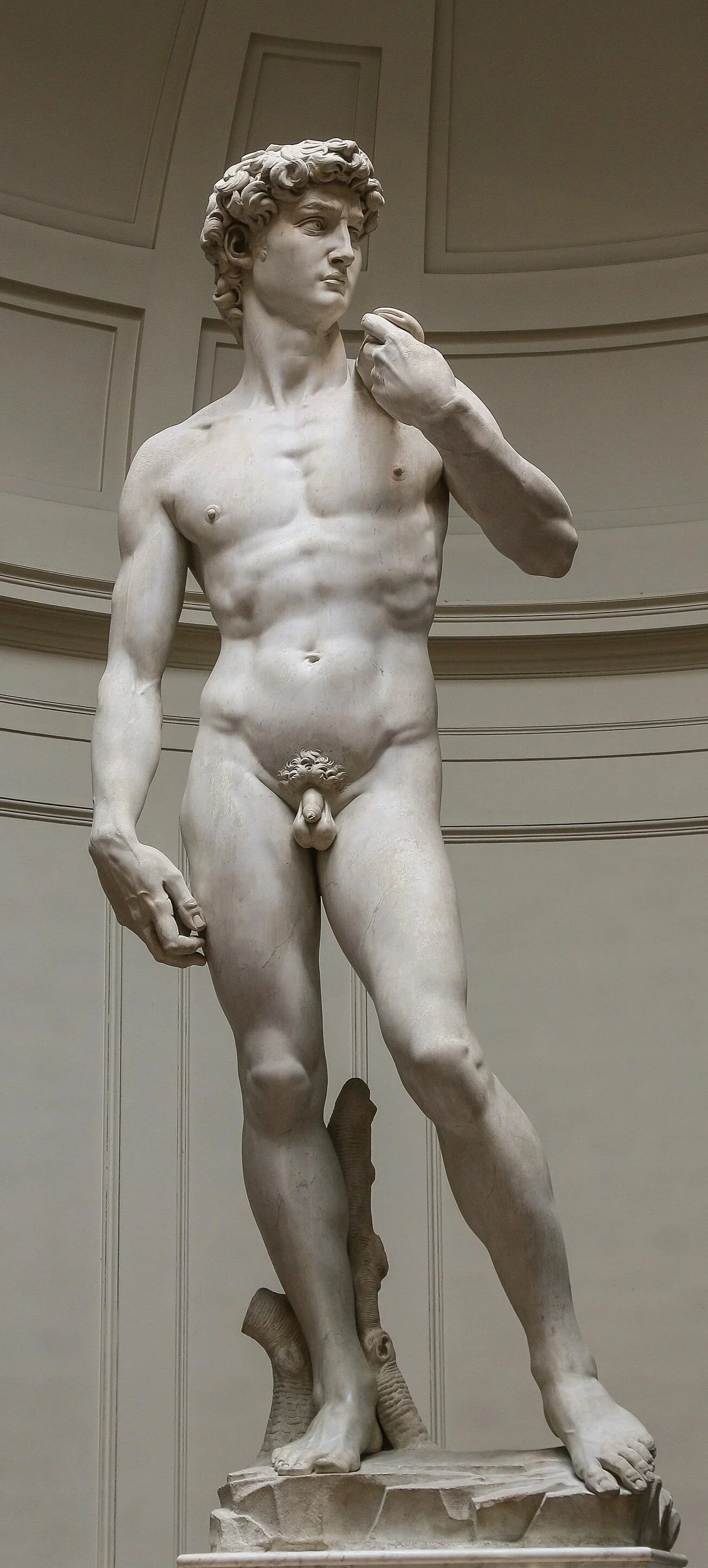
Michelangelo. David. c. 1501-1504. Galleria dell’Accademia, Florence.
-
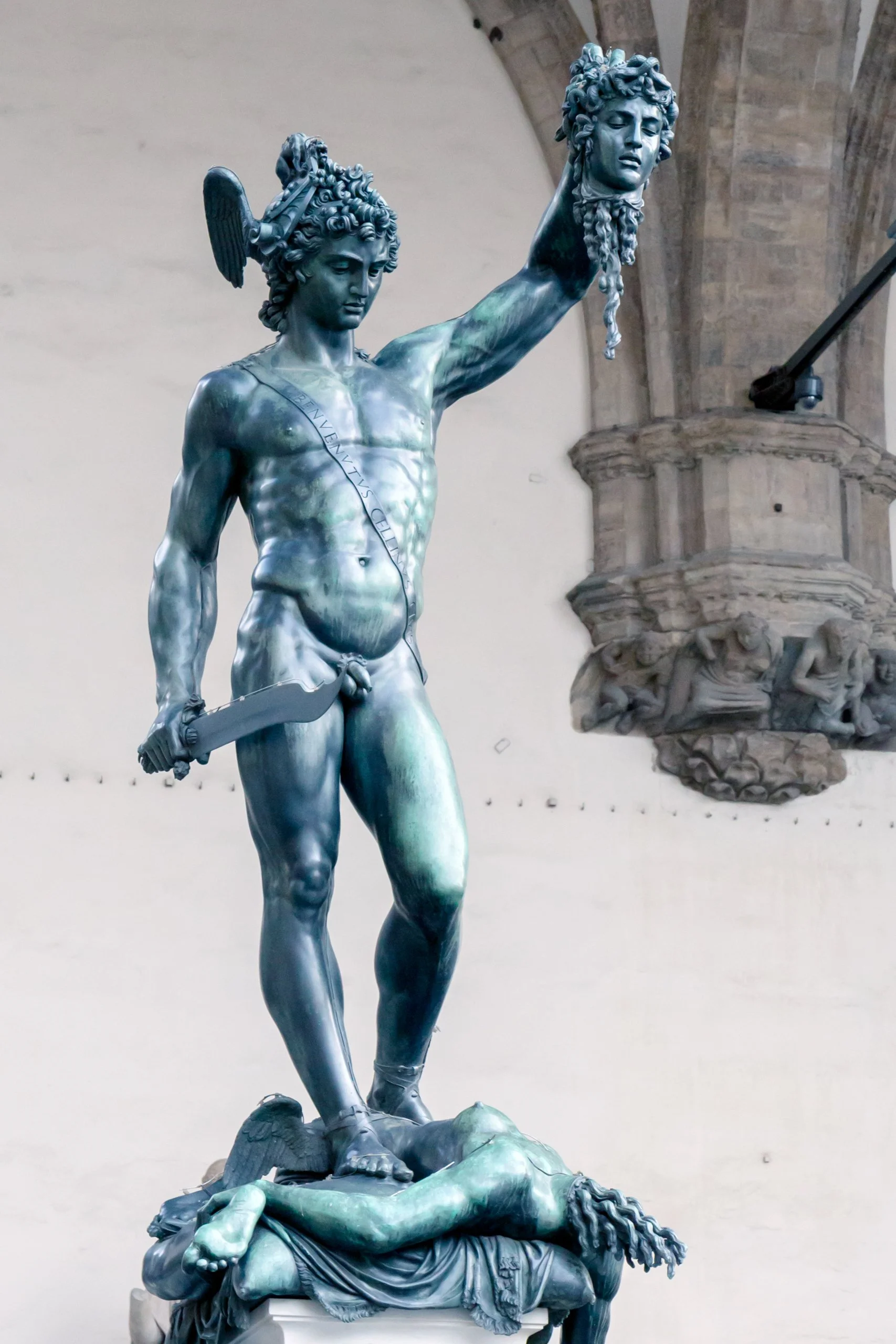
Cellini, Benvenuto. Perseus with the Head of Medusa. 1545-54. Loggia dei Lanzi, Florence
Why did you pick the work you did?
Picking David allows me to talk about several things. First and foremost, David is a sculpture that belongs to a particular place, which allows me to talk about the importance of urban spaces in Renaissance Italy and why that matters. And it was such a contentious sculpture.
It was commissioned by the city government at a time when they were facing threats from the Medici family. The whole Medici family was exiled from Florence in 1494 for various political reasons. The Medici were also some of the biggest, most powerful and innovative patrons of the arts, but they also had a very antagonistic relationship to the city which they wanted to both control, and also participate in as citizens while they made a lot of money. They were extremely rich, primarily because they were bankers to the papacy. They became one of the biggest banks in Europe, and that allowed them to patronize the arts. They have a very ambivalent position in history as being either tyrants trying to control the city or very enlightened patrons of the arts.
The David was commissioned in 1501 by the city, and it became clear as Michelangelo was sculpting it that it was becoming a political symbol. The city had a big block of marble that had been abandoned as a useless piece of marble, and they figured they would try to use it up. And so they had a competition. Michelangelo won that competition in order to sculpt an image for Old Testament heroes that they were ultimately going to install along the roof of the Cathedral of Florence.
So, this is a city commission. He works for, in total, about four years—from around 1501 to late 1504 before they unveiled it. For some reason, there was a decision made that the sculpture was not going to be put in the cathedral. It was going to be put somewhere else, maybe because it was becoming too valuable or becoming too political. So, they had this meeting and the various people, depending on their relationship to Michelangelo and the city, advised the government where to put it–for example, under arches in the square, inside the public town hall, or back on the cathedral. It has been speculated that what the government was doing was trying to gauge the local support for the Medici family exiles. The Medici family had built up a political party through their patronage of people who were loyal to them, and there was a big faction in the city that were loyal to the Medici. So, the government was a bit nervous because the Medici, by this time, were trying to amass mercenary soldiers to re-enter and take back the city.
The sculpture is of the young David from the Old Testament who slays the big, ugly giant Goliath with one stone from a sling–and he does it without armor. Then he takes a sword and cuts the giant's head off. Florentines consider him to be a metaphor–an allegory for the city itself, because ‘here was little Florence and we're defending ourselves against all these big enemies that we have.’ So there was a kind of identification with David. There had already been a number of sculptures of David in Florence at the time and they all had real political meaning.
Some people think, therefore, the government was asking: ‘okay, if we're going to put a David in a public space, in our central square, would that be a provocative message to Medici supporters?’ Here is this David defending, at least symbolically, the city of Florence again, and who would be the Goliath? The Goliath would then be understood to be the Medici themselves. They built an apparatus to transport the David, but left it out overnight, in transit. During that night some young boys began throwing stones at that apparatus–in other words, trying to attack it. That was an indication to the government that there were people who were in interpreting it as a provocative gesture against the Medici. One of the statue’s nicknames was Il Gigante, because it was this big giant man. And so by throwing stones at it, in a way, perhaps they were trying to reverse the story, so that the boys throwing the stones were the David and Il Gigante was turned it into the Goliath–the big, ugly giant. So there's a lot of political symbolism going on that might have erupted into real violence. But I think they felt relatively confident that they could put the statue in front of the main entrance to the town hall, the Palazzo Vecchio of Florence, symbolically protecting the city. And that's where they put it.
The last thing that Michelangelo did to it, on site, was sculpt the eyes. If you look closely, he sculpted the eyes [in such a way that] they look like they have real vision, which was not normal for sculpture at the time. In stone sculpture before the David, you'll often see blank eyes that almost look like they're blind. That's because normally, sculpture would have been painted and they would have painted the eyes. They would have painted the clothing; they would have painted their skin. Michelangelo was the first sculptor in Italy who said, ‘I don't want any paint near my sculptures.’ He just really loved the white stone so he insisted that his sculptures remain unpainted, which created a trend, and everyone after would not have their sculpture painted.
The David stands in front of the Palazzo Vecchio and his head is turned to the left which means he's looking south. And the idea is that audiences would understand that looking south meant that to the south was the Goliath. So people would understand, therefore, that the Medici, who were in Rome to the south, would be the enemy that he's looking at and was maybe about to throw the stone. That therefore became a rallying cry for a certain kind of partisan politics, in the form of a symbol that was already associated with Florence.
A Medici Pope was elected in 1513. The Pope was able to install his family back into Florence and that was good news for some people in Florence and bad news for others, but David was such a popular statue that they couldn't touch it. Until about 1530, Florence was a republic–an autonomous, self-governing city-state that elected its own government by the political class of men who are allowed to vote. And so this was a transformation which was huge and traumatic for the city because now they were being ruled by a Medici duke who was not elected and the office became hereditary. The Duke knew how popular the David was so he didn't want to get rid of it, even though he knew it was an anti-Medici symbol.
You see the David and then just across the doorway is another marble statue of Hercules. There's a statue of Hercules who's kind of looking back at David and he's got a prisoner between his legs and a club and he's about to club him. This is the story about Hercules who beat up Cacus, who stole his cattle. And so we think that the Duke commissioned that statue as a way of visually stopping the gaze of David by countering it, positioning Hercules as a kind of hero that could stand up to David–a kind of visual counterweight. That statue was widely hated and despised by the Florentine people. We have evidence of people attaching satirical poems, attacking it, attacking its ugliness, and attacking the sculptor who made it–not attacking Duke directly, but using the statue as a way to criticize him.
Obscure Work: Benvenuto Cellini’s “Perseus with the Head of Medusa” (1554)
In 1545, Duke Cosimo commissions Benvenuto Cellini. Cellini is like the Forrest Gump of the 16th century–at every important event he was there. And he was the guy that was the hero of the day. He sculpts the Perseus out of bronze and that's a big deal–bronze is very expensive. The technology is very, very labor intensive and that Perseus is the first large-scale single-cast bronze sculpture since antiquity.
Perseus is sent out to kill the Medusa. He was supposed to die trying because it was punishment for him by the king who sent him out. But he manages with the mirror shield and, by not looking directly at Medusa, he is able to kill her and sever her head and put it in a bag and bring it back to the court. And then this is the moment that the sculpture is portraying: he’s taken taken her head out of a bag and is showing it to the king and the court. And of course, everyone there turns to stone.
That's the power of the gaze. An art historian, John Shearman, proposed that something is going on here in the square. In other words, what is happening is the transformation from the sculpture of politics to sculpture as art. So the political conflict that was being dramatized through David, Hercules, and now Perseus was actually being transformed into a game of art between the sculptures. In other words, if you stand at a particular place in the square and you look at the David on the one hand and the Perseus on the other, you can imagine that the David is actually looking at Perseus. And Perseus is holding up the Gorgon. So in other words, the game then becomes one–and this is a very, very important trope in Renaissance art–the early artists were trying to outdo [each other and] the ancients in terms of art and architecture and monumentality and whatnot. And then each succeeding generation of artists or sculptors or painters was conscious of trying to outdo and be better than their predecessors. And so this has been interpreted as Cellini dramatizing the way in which he outdid Michelangelo. And Michelangelo was the standard, right? So he outdid him, not only because his sculpture was more beautiful, but it was more technically difficult to produce. It was in bronze, which was more expensive than marble. And as he holds up the Medusa, he has literally turned his rivals into stone. So this is an artistic game going on in the square because Benvenuto Cellini was very conscious of where he wanted his sculpture to be. He wanted it there. And there was a sculpture already sitting there that they moved in order to accommodate him. And so now you have that constant drama between Cellini and Michelangelo which is done by proxy from Perseus–the ancient Greek hero against the Old Testament hero of David.
Would you say that the Perseus is equally as politically symbolic or less so than the David?
I think my response would be that by 1555 political tension between those who believed in the Republic and those who were interested in following the Duchy was becoming less and less relevant because it was clear that by the middle of the 16th century that Cosimo was creating a much more modern territorial state [through adding conquered territory].
And so he's creating a larger territorial state in which Florence is the capital, whereas the Republic was a city-state. Duke Cosimo is trying through certain sort of diplomatic, political and economic reforms to try and create a larger state. And so I think that the time for these independent city states was over in a sense.
So Cellini didn't have to worry so much about that. I think that if you take the interpretation I gave you, it's more of a personal thing between him and Michelangelo and the past. And Cellini is working for the Duke, so it's political because the Duke is basically using sculptors to create a new symbolic apparatus for his own state. So the Perseus would have been one of many projects that include sculpture, new urbanism, new institutions and whatnot that would all be part of a larger coordinated effort to show Florentines that you belong to something bigger and that it's controlled by the Duke, right? And [it comes from] his largesse because he's paying for it. So it's political insofar as I think it's furthering the Duke's agenda, but I think that the politics is much less about the past and much more about the future.
I'm interested in your idea that the location of a sculpture really is essential to understanding its meaning. Originally the David was meant to be in this cathedral. Do you think that if it had ended up in the cathedral that the meaning would have been entirely different?
Location matters so much with sculpture at a time they didn’t have museums. I think it would have been very different if it was up on top of the cathedral way high up–you know, 80 or 90 feet high. It's a big sculpture, but at that distance wouldn't have looked as monumental as if you're instead looking directly at it, so you have a different personal relationship to it. So I think it would have been in effect almost forgotten or just part of the scenery because it's really, really difficult to establish a relationship with it at that distance.
It's extremely important where you find sculpture, because where it is will really determine the meanings, especially with public sculpture. It's always politically charged when you're dealing with public space. So it's just something to remember because often sculptures end up in museums. So now you see the David in front of the building, but that's a copy, right? The original is in a museum to protect it, but also to allow a different viewing experience. But in the museum, it takes on an even different kind of meaning and in fact, the story I told you doesn't really mean much in the new position. The new position is more about Michelangelo as a sculptor, right, and the ability that he had to transform what was considered to be a useless piece of stone into a thing of beauty. So that's a different narrative now. And it's hard to remember that it was such a politically volatile thing.
Tell me personally how these speak to your interests and why it's important to research them.
I'll tell you a little bit about my trajectory. I studied art making–I actually went to art school as an undergrad, but I wasn't great at it. And I fell in love with art history. As an undergrad, I was studying mostly art in the 19th, 20th century. I never studied the Renaissance. Then I did my master's thesis on an artist who would project images onto buildings and monuments. That got me interested in the meaning of public spaces and art in public spaces and the political content of those gestures, and so when I went to do my PhD I proposed to do it in the Italian Renaissance. And I brought that interest in trying to understand urban space through the experience of people living in it at those moments and how they understood what we understand as works of art and architecture as things they lived with–as part of the whole apparatus of their social and political lives–because they encounter them in a very different way than we do. And so I was trying to get to that.
