-
Caillebotte, Gustave. Paris Street; Rainy Day. 1877, Art Institute of Chicago
-
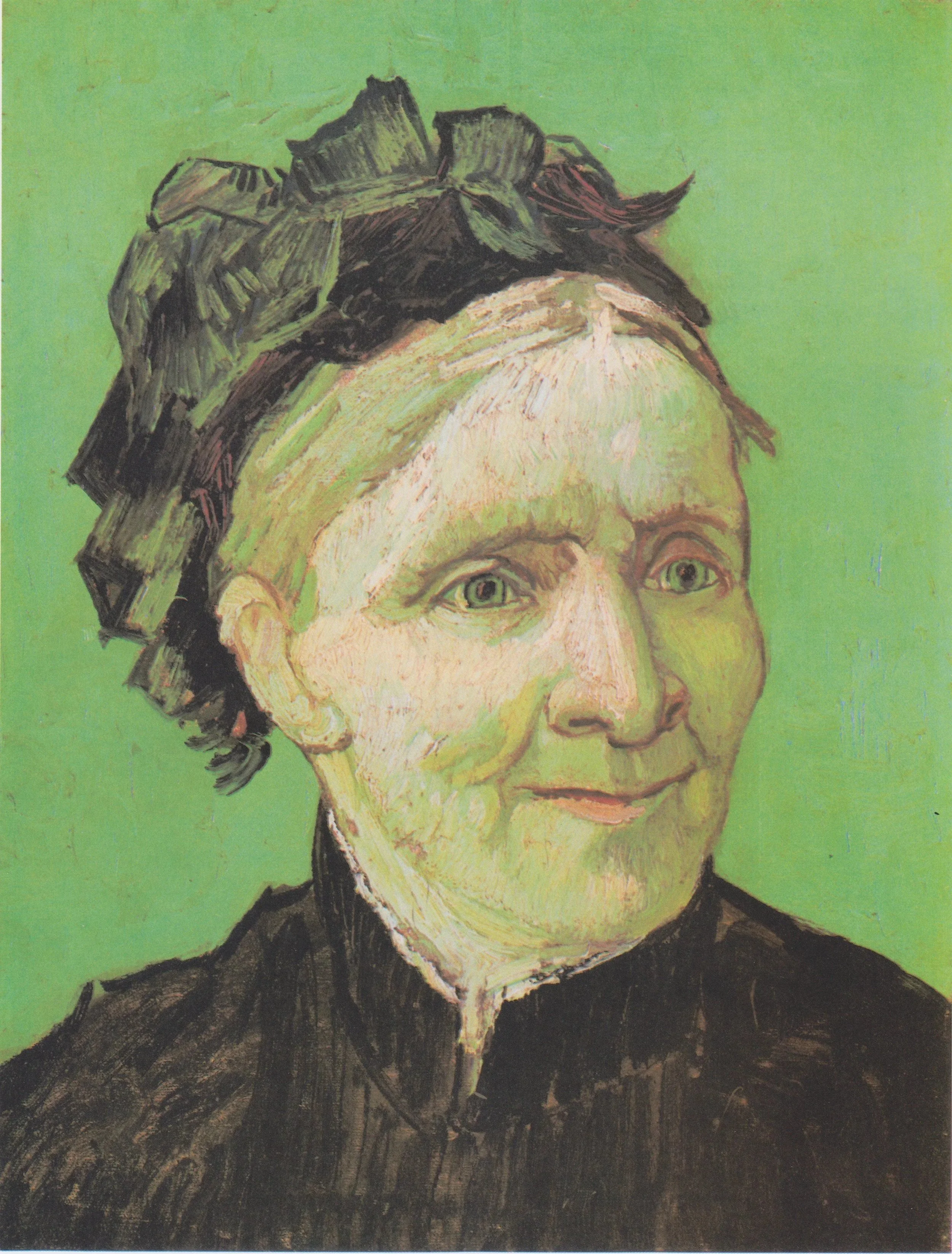
Van Gogh, Vincent. Portrait of the Artist’s Mother. 1888, Norton Simon Museum of Art, Pasadena
Tell me about what this work means to you personally
I think Caillebotte’s Paris Street; Rainy Day is an amazing piece of work.
We are so exposed to the Impressionists. We think of Impressionism as soothing, nice art that people have on umbrellas and their merch. But of course, at the time, a lot of people thought it was shocking, ugly, and just so plain that it would make you die of boredom.
Caillebotte was an artist who didn’t have to work. He was independently wealthy. But he really wanted to be part of this movement of people who painted outside, in person, in full air, as it’s called in French, plein air. He painted a lot very close to his apartment in Paris, and whether that was just convenience or he was really interested in the dynamic new cityscape, he was clearly a very enthusiastic witness to the new Parisian world.
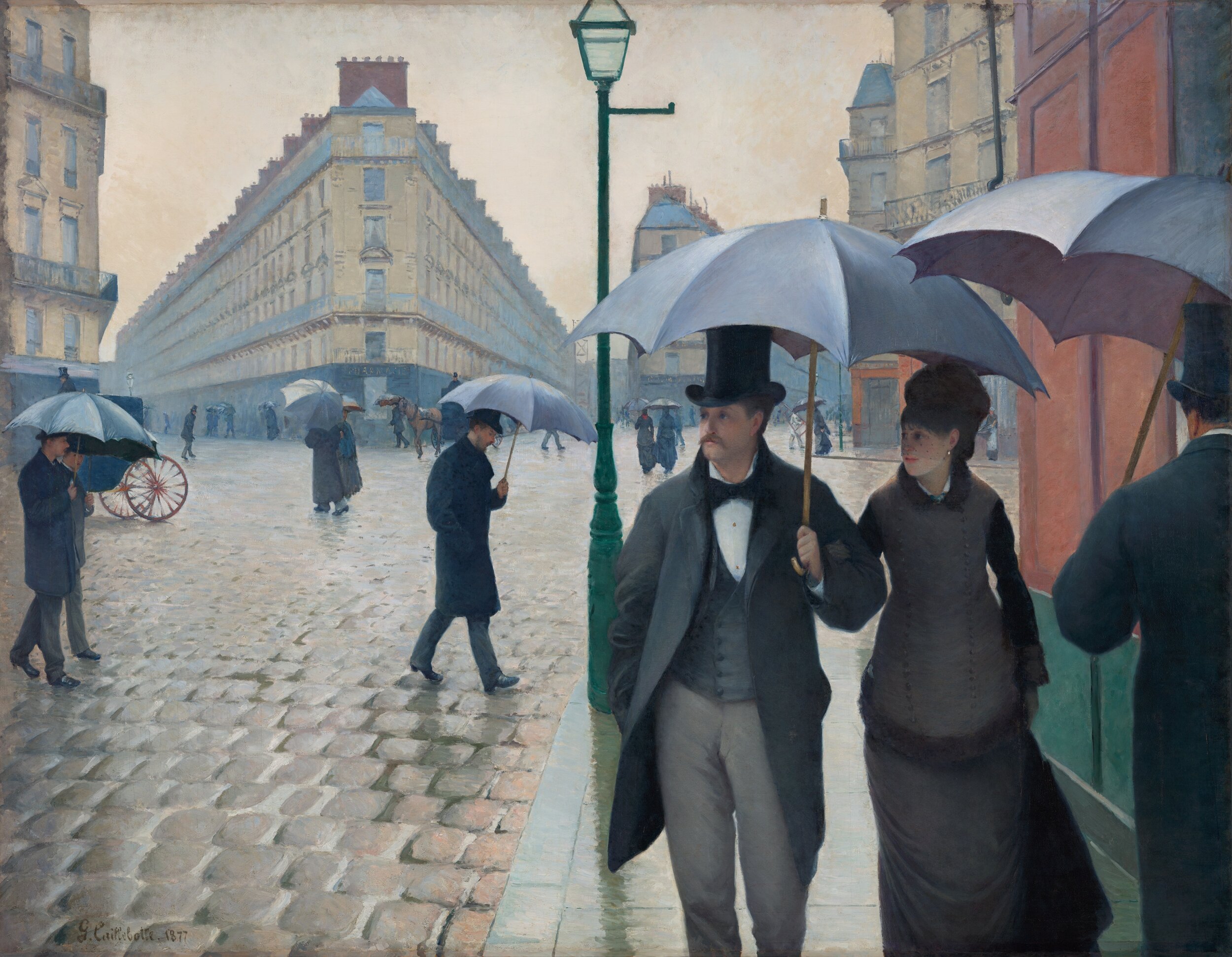
There’s no way he could have set up his canvas and painted this marvelous, giant street panorama outside, certainly not while it was raining. So he spent a lot of time observing people, notating, drawing them, and put it together in a kind of beautiful, grand masterpiece. One that could stand alongside works like Raphael’s The School of Athens, a picture that reunites the whole world, a great altarpiece, or a work of Buddhist art, where you see the whole world as the artist sees it.
So it is Paris. It is these new streets that cut across at all angles. It’s men and women. And you see them in the way they would dress and the way they would act. Some of them are carrying ladders because they’re workers. Others are carrying fashionable umbrellas and top hats. If you go to this particular intersection, of course, it doesn’t look quite the same today, but you’ll recognize all the facades. All the buildings look that way, but they look 10 times as big on the canvas. There’s something—I’m not sure if it’s actually incorrect proportions—but there’s just something monumental.
In a way, [the people] are close to life-sized. The couple you see on the right, the man and the fashionable lady with the little black dots on a transparent veil—little details of everyday upper-middle-class existence like that mattered enough to Caillebotte to record accurately—look like they could be greeting you. In fact, they seem to be greeting someone we don’t see to their left.
It’s a painting that you feel like you can almost step into, I think. And a lot of that has to do with the light. It’s a rainy day, and it has a kind of feel as if there’s sunlight underneath clouds. It comes at you in this weird, muted fashion.
I remember seeing it for the first time when I was maybe [about 16] in a textbook, Gardner’s Art Through the Ages, and being impressed by the little puddles between the cobblestones. These little shapes, little interstices between the cobblestones, where the water had gathered. And I remember thinking that you notice things like that when you walk around somewhere, but those details wouldn’t have been necessarily considered worthy of art, maybe only to show off a painter’s skill. But interestingly, for Caillebotte and the Impressionists, it wasn’t about showing off. It was about the puddle being as important as the diamond earring, or the person’s face, or their soul.
And I wouldn’t say the Impressionists were all modern people who didn’t believe in God, or were sort of bent on progress. But whatever they thought about life, about the nature of human beings, they thought you should be able to see it; they were interested in how the world looked. And I think there’s still something exciting about that, even if we don’t dress or look the same today.
In your book The Forest of Symbols, you note that the figures in the painting seem psychologically inaccessible. Can you expand on how this painting speaks to the era’s urbanization?
There are different attitudes about this. Some people think that in this period, the city became a weird new thing. It definitely grew. There were more people living in the city. And some of them felt anonymous. They felt like they didn’t know anyone, and no one knew them. Something could happen to them, some bad thing, and no one would know.
There was even the possibility for the first time of falling in love with someone you didn’t know. How’s that possible? Well, you see them passing by. Baudelaire has a famous poem called To Someone Passing By, À Une Passante in French. It’s a sonnet about a woman that he doesn’t know, and she’s wearing a veil!
So, there was a lot of interest in urban life, and the things it made possible, and the things it made difficult. People on the street wouldn’t all be your friends and neighbors as in a small town. But I think some of this sense of psychological distance is also just normal human nature. Even with our closest family and friends, we don’t know what they’re thinking. So, I think there is something about this metaphysical privacy. There are parts of us that only we know. And maybe we don’t even know; there are parts of our subconscious that are inaccessible to us.
So looking at a painting like this, I think it’s very natural to wonder, “Hmm, what is he thinking? What is she thinking? What is that person thinking?” Suppose you’re interested in male friendships and possible homoerotic connections, there are a lot of men greeting each other and glancing at each other, handsome men with mustaches, in this painting. All of the people in this picture lend themselves to this question. Are they glancing somewhere or thinking something that [people at the time thought] they should not? Paintings don’t talk. So we can use our imagination in some ways that we wouldn’t in a play, or an opera, or a film, especially for this analysis of where their eyes are going, who’s looking at what.
What thought went into choosing Van Gogh’s Portrait of his Mother as your favorite obscure work?
This one picked me, you could say. I remember going to the Norton Simon Museum when I was in ninth grade, and looking around its many ancient and modern works, the Impressionist-era stuff, and I caught a glimpse of this picture.
It is a very strange picture. If you think of Van Gogh’s beautiful, vibrant colors in The Starry Night or The Night Café, it feels very different. It is bright, but it’s greenish, ranging from shades of green to lemon yellow. And it’s recognizably a portrait of a person, but, again, compared to his other portraits, it looks different, it looks strange.
And I was curious why. And I learned that the painting was based on a photograph of her that he had. His sister had sent a portrait of his mother. It was one of these little photographs called cartes de visite, just a bit bigger than a business card today.
He said he was happy to see that his mother was in good health, but he was annoyed by the black-and-white photograph. He wanted to see his mother as he imagined and as he knew her. This just isn’t your average Van Gogh picture, and the only explanation I can think of is that he wanted it to be true emotionally, despite only having a black-and-white photo of his mother to reference. He didn’t sit around and paint rosy cheeks on her, which he couldn’t see. He followed the photograph’s monochromatic pattern with what he called warm colors. He wanted to capture his mother’s personality with color, not just her outer appearance.
I think this is interesting in terms of how we individually see things. One of the most amazing ways we can tell that our minds differ is by comparing colors. Why do we have a favorite color? [Do people] like different colors, or [is it] because we see those colors differently? In A Forest of Symbols, I follow the ideas of this great philosopher, Gottlob Frege, who said that while you can ask someone to describe what something looks like to them, they’ll answer in terms of what’s going on in their own mind. And you cannot, without becoming them, truly know whether they see the same thing as you do. There is something special about the way each one of us sees and conceives the world. It’s just that we can’t convey it directly. The only thing we can do is make art.
And I think that’s what Van Gogh is doing. He’s very good at it. He’s very good at making you feel things. But I wouldn’t kid myself. I don’t feel exactly what Van Gogh felt, because he was a very emotional and very intelligent person who saw things, and felt things, and thought things that were not what everyone else saw, and felt, and thought.
It’s one of my favorite pictures. Aside from all that theory, I’ve been seeing it over a course of 30 years and it’s one of the first paintings that I can remember being impressed by, not because it was the prettiest or most impressive work in that collection, but because it had something mysterious about it, a story that I don’t think we’ll ever get to the bottom of, which really interested me. And that’s why I wrote about it in that way in the book.
Why is the study of art history important, or how does it inspire your passion?
I think it’s because, besides being social people who have jobs, or families, or interact with each other in public, we are all also private. We are also creatures. The way a tree grows and orients itself to the light, the way an animal is hungry, or thirsty, or scared, or happy. We have all those features ourselves, as the kind of creatures we are. And that means art, even when it’s very cerebral and very learned, touches on aspects of ourselves that are not fully under our control.
I think if we ever meet extraterrestrials, art would be one of the most interesting ways that we would learn about each other. But in a way, we still don’t know everything about ourselves. I think art is right up there with science as a means of moving towards understanding ourselves. It’s also part of understanding the physical world since art is made out of the materials around us, and it affects us in very particular ways.
Art is a lot of fun, and that is part of its usefulness. It’s not useful because of its function. And I think a lot of art historians say, “Oh, the artwork is very important for the prestige of a king,” or, “It was important for a particular commercial or political reason.” That’s all true. But we still look at it even though we no longer have the same economy, the same politics, the same religious beliefs that gave rise to it. And I think that’s important. I don’t think we’re misunderstanding it. I don’t think you’d have to beam yourself back into the moment of its creation to fully appreciate it. Because it’s not exhausted by one purpose.
And I think we’re not either. We have multiple sides to ourselves. It’s good to remember that, because it’s easy to reduce people to the parts of them that we can calculate. But the other parts will still always be there.
How do you think these two pieces speak to each other? I noticed, for example, that they both seem to have a relationship with photography or evolving technology.
Photography plays a role, but a different one in the two cases because, in Van Gogh’s case, he was using photography as everyone was during this period. But he was also kind of annoyed by its limitations. He wanted to see his mother.
He was using photography very directly. What’s fascinating is that he still respected the limitations of his knowledge when painting his mother’s portrait. Although the photo wasn’t spinach green, he respected something about not seeing the full gamut of colors, as opposed to colorizing his mother.
In Caillebotte’s case, he lived in a world where the city had been photographed for the first time in the past 30 years. In an interesting way, like Van Gogh, he was doing something that he thought photography could not do and probably would never be able to do, which is to render our world in full dimension, full color.
So, to achieve that in a monumental or life-sized oil painting, the painting is like two eyes, with no dependence on a single standpoint. The reason it’s so big and spacious is that the viewpoint is moving. And he’s presenting this whole scene, which in some ways is closer to what you see in real life. Looking at the paint is closer to being embodied and being able to navigate a space. You can do that with your eyes.
People in the 19th century often felt that photography had taken something away from art. If you wanted to see what someone looks like, you could photograph them. You didn’t have to wait for a painter. They were using painting, for instance, and other art forms to explore things that photographs had trouble with, like how something feels, the interior portrait of someone.
In those 19th-century 3D photographs, stereographs, there would be two nearly identical photos on two sides of an optical device. And when you look through them, things stick out. They’re 3D, but you still don’t get that panoramic sense that you get in this picture, because the effect is to create projection, not to open up the whole world. And if you use a wide-focus camera, things start getting distorted. So you could see more, but they wouldn’t all be in parallel. Painters, therefore, can cheat and create something more like what you really see than what a bunch of light hitting some film can create.
I also don’t know whether Caillebotte ever saw all the people in the painting at the same time. We have a lot of studies of individual figures, and he put them together like a symphony.
