Can you tell me why you ended up picking these two works?
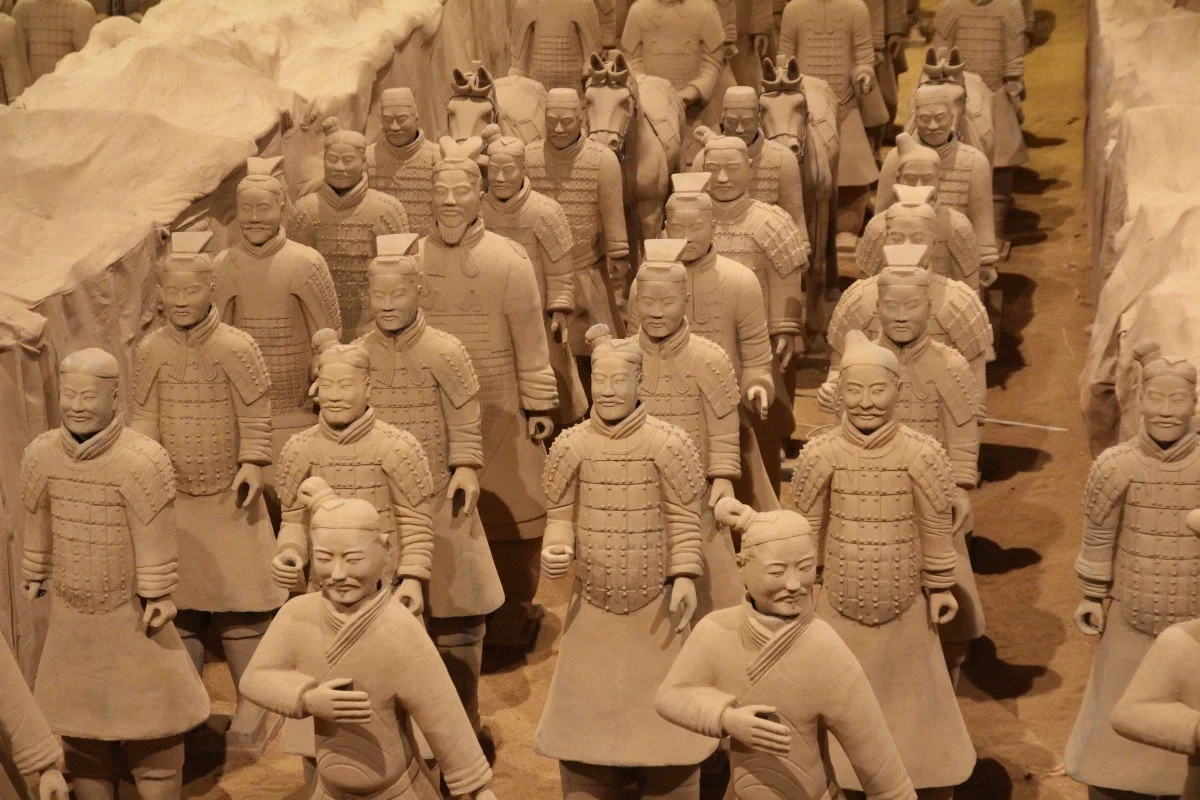
The First Emperor’s tomb complex and the Terracotta Warriors are known as one of the so-called Eight Wonders of the World. There are numerous publications and a great deal of media coverage of the site, and although the narratives are largely fine, they miss a crucial point being made by the tomb’s design. The deeper narrative is not what the popular coverage makes it out to be. As a specialist who has worked on it for quite some time, I take satisfaction in telling people, “What you see is just the tip of the iceberg. Let me tell you the deeper story.”
First, the situation. You have the tomb itself, not yet opened, where the First Emperor’s body is supposedly buried. About one mile to the east, you have the terracotta army formation. The tricky part is that the warriors all face east, whereas the half-size bronze chariot, widely believed to be the emperor’s, was found to the west of the tomb and faces west. It’s almost as if the emperor’s spirit—the commander-in-chief—is saying, “Thank you for defending me. I’m leaving you.” That is the apparent contradiction.
Then there is the problem with the current theory. The figures are life-size, which is very rare. Chinese funerary figurines were always reduced in scale, both before and after; this tomb is the only instance of life-size figures. That lends itself to the popular conviction that they are there to defend the tomb, and the BBC and other large media outlets still more or less go along those lines.
But there’s a serious problem with this defense theory: none of the terracotta warriors wears a helmet. They are not battle-ready. And it’s not that there were no helmets. Tons of them were found in a pit close to the tomb, and they were made of stone. So you have helmets that could not be worn and soldiers not wearing any helmets. The obvious implication is that they are not getting ready to fight, because they are not defending anything.
My inquiry starts right there. We need an interpretation that sticks to the facts and explains them: the warriors face the opposite direction from the chariot, and they are not battle-ready. If they are not there to fight or defend, what are they for?
My conclusion is that current theories treat the site as too static a model. My theory is that the whole site enacts a cyclical model, based on the idea that life is possible only if you follow the seasonal cycle: spring, summer, autumn, winter. It is an ecosystem. What the warriors to the east of the tomb are enacting is a ceremony called “welcoming the spring.” The whole site is a massive, gigantic enactment of the seasonal cycle.
Here we need to suspend our modern understanding of how to keep something alive. In the West, we bury someone and imagine that, for that being to live on, or to come back to life, it will assume its old form—some kind of figural shape. That was not the Chinese understanding at the time. Before Buddhism came in, the ancient Chinese didn’t trust the body as a vehicle to carry the spirit forever. Their premise was that the body would be gone. The medium that carries life, they believed, is qi: some kind of energetic, vital form. It is the baseline medium of our body, our life, and the universe. Everything comes down to this energetic form.
It’s also this idea of breath, right?
Exactly. I translate it as “breath,” though that is a makeshift translation. The Greeks would call it pneuma. It actually resonates with the twenty-first-century understanding of the universe: in the end, it’s not solid matter—everything comes down to some kind of energy field.
So in the First Emperor’s time, they believed that to keep life possible, you should create a larger ecosystem. The body will rot and disintegrate, but they hadn’t given up hope for some kind of life form. So they created an ecosystem in which energy is renewed and recycled. They were realistic about it: no one has been to that other world, so we can only operate on certain premises. But if we stop worrying about the body as a container and instead keep the ecosystem alive, then we can entrust everyone’s body to that system. If the system keeps going, there is hope that the form that once resided in the body can carry on. I think this whole tomb complex banks on that idea.
So are you saying that this ecosystem is a divine physical space, or is it more figurative?
It is physical in the sense that you do have all these layouts. But it is not figurative, because the energy form doesn’t have to take a figural form. It is more like a self-renewing system, a kind of machinery, and the figures are there to play their parts. The terracotta soldiers are performing a moment called spring, when energy is growing, when the sun is rising. Elsewhere, other figures perform other seasons. So the figures themselves don’t matter as much as the moment, the phase they spell out, so that the whole machine keeps running. And if the machinery is alive, and we are all part of it, then we can talk about life.
There was a great quote I remember reading that said the First Emperor’s court can be thought of as constructing an earthly simulacrum of heaven. I feel like that really applies to what you’re saying here. Would you agree?
Yes, except that we don’t want to take “heaven” too literally, as simply what is above. Early Chinese heaven is very different from the Christian heaven. It is more of a state—one that can be rotated back to the underworld. At one time it is heavenly qi; later, that heavenly qi can be rotated into earthly qi. Nothing is locked in place. So in understanding early Chinese cosmology, one needs to avoid the static model. Heaven is a state that can evolve and morph into another state, which is earth. In fact, the metaphor in the early understanding of heaven is the wheel.
A cyclical image, I guess.
Yes, exactly. Cyclical.
Obscure Work: The Shadow Cave and Cave 254 at Dunhuang
The other work I picked deserves much more fame. Think about the crucial role of Plato’s cave, the allegorical cave Plato describes in The Republic. It is a fictional cave, but it holds a crucial place in the entire imagination of Western intellectual history. Film studies, for instance, doesn’t take the Lumière brothers’ invention of cinema as its starting point; it traces cinema as a conceptual apparatus all the way back to Plato’s cave. And philosophers constantly use that cave to stage how one comes to know the real truth versus delusion. No one would dispute its centrality in the Western imagination.
But what about other parts of the world? There is an equally important cave that people in the West don’t know much about: the Shadow Cave. It is located in what is now Afghanistan, which used to be the Gandhara region, where West and East met. And it is a real cave. It was documented in early texts we still have, and Chinese monks, pilgrims, and scholars of the fifth and seventh centuries actually went there and located it. Specialists know it very well, but the general public has very little idea about it.
Yet its importance is the same as that of Plato’s cave, because it is about epistemology, about knowing what is real. And it is a counterpart to Plato’s cave. In Plato’s cave, prisoners are captivated by shadows projected onto the wall by a light source behind them, and they think those shadows are real. Then someone turns around and says, “There’s a light source outside the cave. We should go out, rather than being captivated by what is projected on the wall.” The Shadow Cave, in the Asian case, says instead, “Actually, there’s a lot going on on that wall, and that’s where you will gain insight: by looking at that wall.” It does not denigrate the image on the wall.
Can you tell me a little bit about the religious significance?
An early text tells how poisonous dragons, called nagas, were making trouble for the region, which is near present-day Jalalabad. The Buddha flew through the air with his entourage and came to subjugate them. (The historical Buddha never visited that area, so it is fictional.) When the Buddha was about to leave, a dragon said, “If you leave, I am going to relapse into my old ways. Stay for another 1,500 years.”
Then comes one of the text’s most spectacular moments: the Buddha leapt into the wall, where he became an image, and that image began to preach the Law. A living being turns into an image on the wall, and the image starts to speak. It’s almost like a cinematic special effect. But what’s the point of this fictional setup?
As you read on, it turns out the author was dramatizing it so that you could visualize the scenario. Then the text does it again, and this time it is not about subjugating a dragon—it is a meditation. Imagine you are sitting outside the cave and beginning to meditate. Then imagine going into the cave, looking at the wall, and visualizing a Buddhist image. Then imagine you see an image on the wall, and so on, until you feel the whole cave is filled with Buddha images. It is essentially an instruction manual for meditation, teaching you step by step how to get from A to B to C. When your whole mental space is filled with Buddha images, the text tells you, your meditation has succeeded.
Interestingly, in the seventh century, a real monk-scholar named Xuanzang—one of the most extraordinary travelers in world history—went from China to India and visited this cave, guided by the lore handed down for centuries. And initially, he saw nothing but a blank wall. But instead of saying someone had lied to him, he blamed himself. As a Buddhist, he believed in karma—that past deeds and intentions cumulatively affect the future—so he felt it must be his karma blocking his vision. What does a Buddhist do then? Repent and meditate. And through meditation he finally “saw” the image on the wall.
Cave 254 at Dunhuang
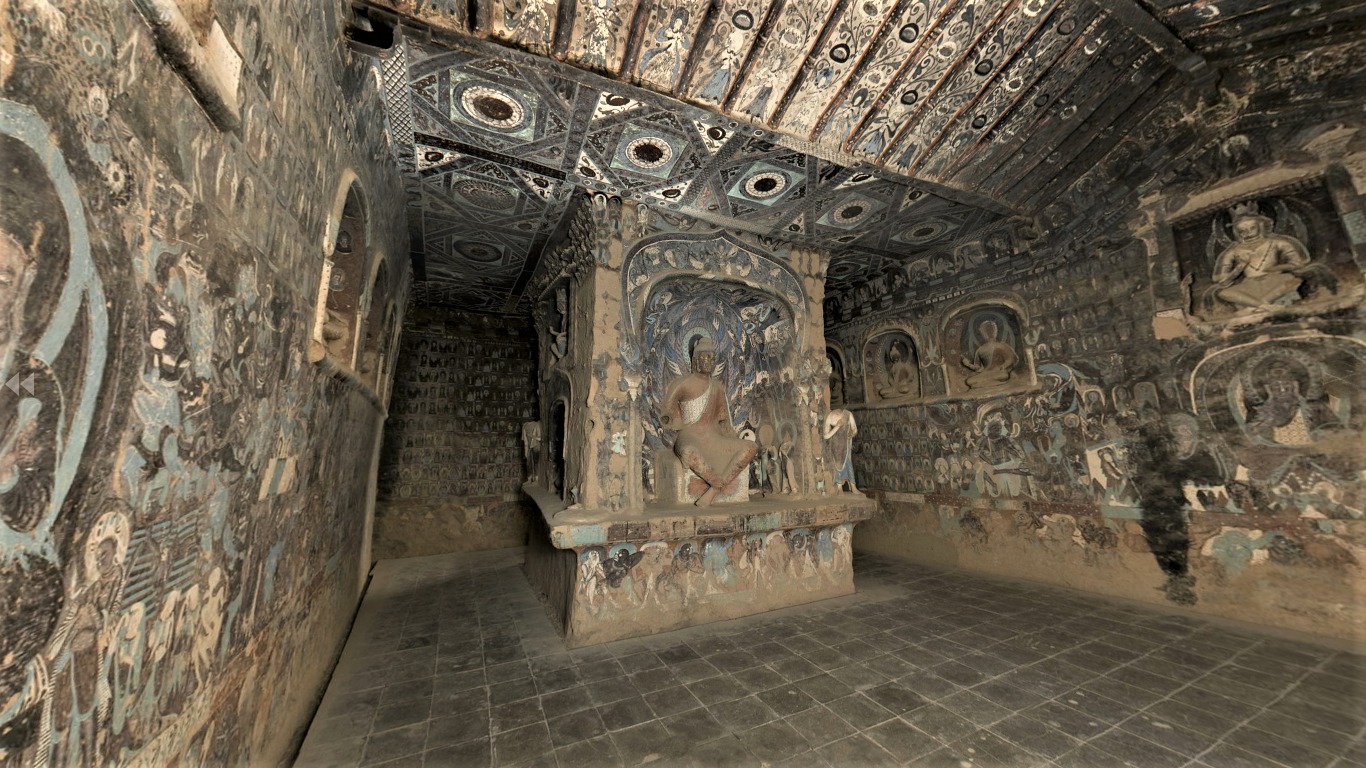
Cave 254 at Dunhuang, in northwest China, is built on the model of the Shadow Cave in Afghanistan. Dunhuang is the largest art gallery in situ in the world: 492 caves of painted murals and sculptures, from the fourth to the fourteenth century. But here is the interesting part: they were never meant as galleries to attract visitors. They were shrines and sanctuaries sponsored by families devoted to Buddhism.
What you see here is a mural on the end wall of the cave, and I think of this as a shadow cave. It is well documented that the idea traveled to China and that Chinese Buddhist communities began making caves on the Shadow Cave model. It is as if someone in Europe had heard about Plato’s cave and started replicating it, except that it happened in Asia. Most people never went to the original; they heard about it and made caves based on that blueprint.
This is a wall with one Buddha sitting inside a painted cave. Isn’t that interesting? You have an image pretending to be a statue, but it isn’t one. It is a painted image in a painted cave inside a real cave. Around it, you have what we generically call “the thousand Buddhas.”
If you drew a virtual line down the middle, you would see that all the Buddhas to the left belong to the past and all those to the right belong to the future. We know this because each little Buddha has a cartouche with its name, and when scholars checked these names against the textual sources, they fell into a very neat pattern: past on the left, future on the right.
So you have the past, you have the future, and in the middle you have a fictive image of a Buddha wedged between them. The real question the designer wants you to think about is: does this exist or not? They were dealing with death, with existence and non-existence, and they wanted you to think about existence in terms of past, present, and future, which was a matter of debate in Buddhist scholastic communities.
That debate is still relevant in the twenty-first century. In modern physics, some say we exist in a “block universe”: add time as a fourth dimension to our three-dimensional world, and every moment exists at once. Think of slices of bread lined up in a toaster, each slice being one moment in the time sequence. Are they all real? If they are, then our future already exists, and some super-point of view not confined to our 3D frame would know that. And with that comes an unsettling question: do we have free will, or are we predestined?
Around 500 CE, Buddhist scholars were already having this debate. Are the past and future equally real? If so, then this being wedged between them is real too. Others said, “No, the past is gone; it evaporated. The future doesn’t exist because we haven’t seen it. The only thing that is real is right now.” And then someone would ask, “What about one second ago? Is that real?”
But the makers of this cave were more interested in a solution to this impossible situation. They were honoring, say, a family member who had just passed away, and they wanted to have it both ways. They created a fiction so that you could point to the being on the wall and say it doesn’t exist—and yet it exists. If you say, “He doesn’t exist,” I can point to the image and say, “Look, he’s there.” But if you say, “Okay, he exists,” someone can reply, “If you touch it, it’s just a surface.” They wanted you in this ambiguous, either/or, neither/nor situation.
That’s why they were interested in the shadow image on the wall. Does it exist? Well, it doesn’t. Does it not exist? Well, you are in its presence. It is a projection. It bypasses the whole issue of whether it is real or not. It can be both, and it can also be neither.
That’s why a cave like this deserves to be better known. Every educated person knows Plato’s cave, which is equally fictional, because it is Plato. But this cave is physically there: you can bring people to visit it and point your finger at the image on the wall. And as art, it has an additional level of ingenuity: a painted image pretending to be a statue, which plays further into the need to make the Buddha both there and not there.
How do you think the two pieces you chose might speak to or relate to each other, if they do? Maybe perceptions of life and death, or past and present?
That’s a very good question. Whatever they have in common, it’s that they warn us against the mimetic premise of art: the common Western assumption that art reproduces how things look. If there is a body, you make a beautiful image of that body. Not all of Western art is about that, but there is a strong impulse in that direction.
These two examples argue against it. In both cases, art is not about capturing appearance. It is about spelling out a deep system, capturing its dynamics, and keeping that system going. Both are about life and death and driven by the desire to be more alive, but they are not hoping that some figural form will come alive. The figures fulfill a function: to spell out a certain state—part of a larger machinery that is constantly changing, often cyclically. They believed the universe consists of multiple stages.
Behind both lies a deep conviction that the world is always changing. So it would be futile for art to depict only how things look. It is more meaningful to depict the shape of the dynamic: the deep process by which energy circulates, renews itself, and becomes something else. You capture the mechanism rather than the appearance, and what you see is just part of a larger system.
That’s why this kind of art speaks to us now. We increasingly find things interesting not because they are what they are, but because of how they relate to other things in a network. Art is sometimes just a nodal point in that larger networked universe. Think about how you and I met because the network made it possible. Meaning emerges from connectivity.
So we need to rediscover Chinese art in that spirit. It is interesting not because it looks realistic; Chinese artists were never really interested in capturing how things look. They wanted to capture some kind of energy form, and to make their art—whether landscape, figures, or topography—part of a system. At the end of the day, Chinese art is an art of systems: an art of capturing change. That’s the message I want to leave you with.
