-
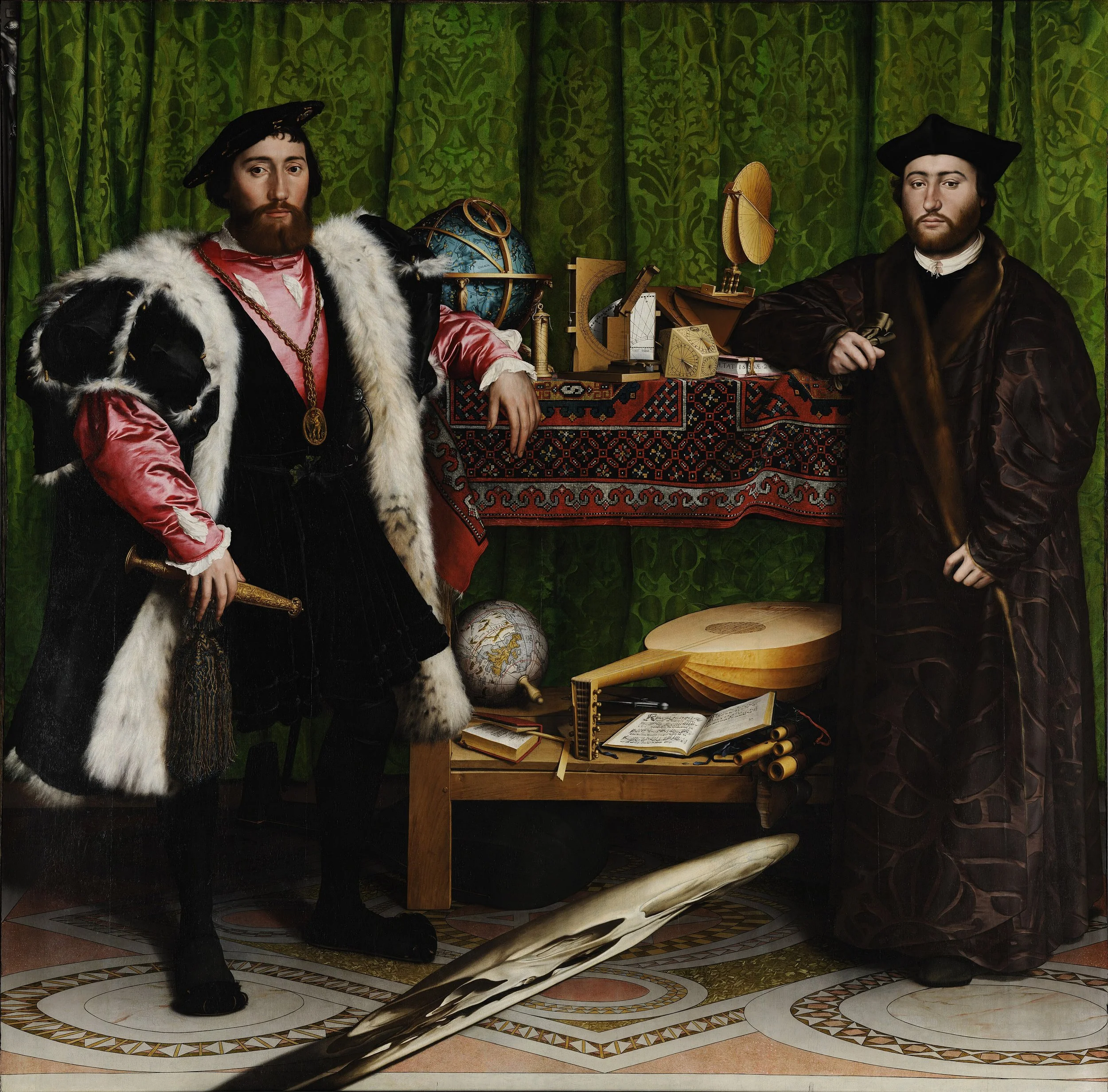
Holbein, Hans. The Ambassadors. 1533. The National Gallery, London.
-
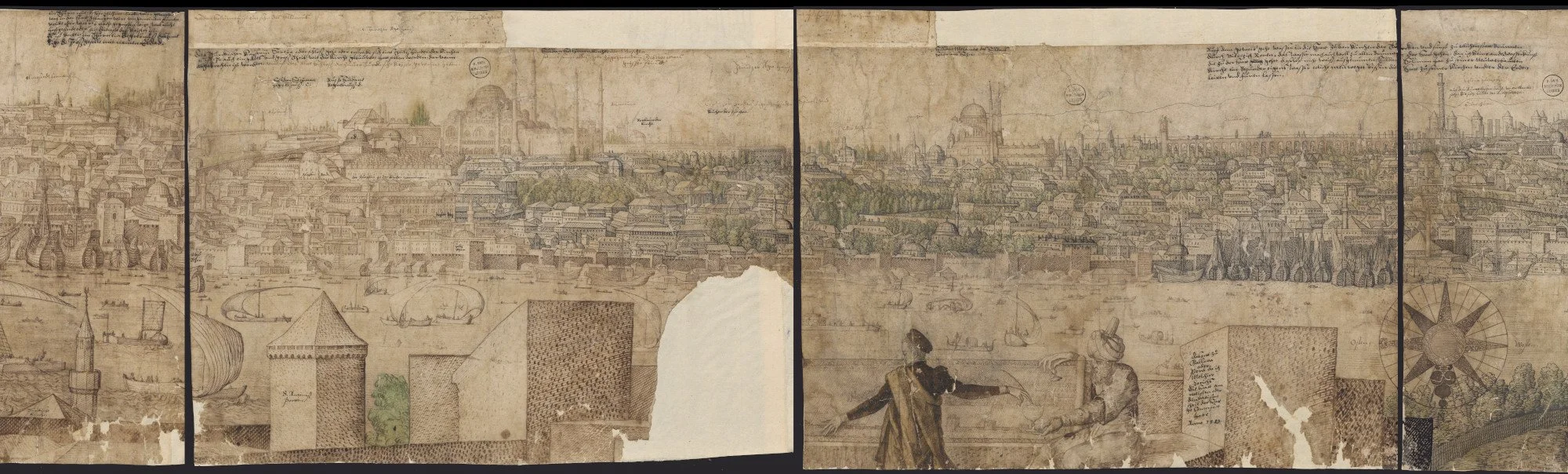
Lorck, Melchior. Prospect of Constantinople. 1559. University of Leiden.
Thoughts on scholarship
One of the things about scholarship, and this is maybe where it’s different from journalism, is that we depend on foundational work that’s done by the people who come before us. Some art historians may be seen as doing work that is innovative and less traditional, but that is often only possible because many scholars did foundational work, such as identifying names of artists and archives and working out chronologies. The nature of scholarship is collaborative. It is important to acknowledge the breadth of work that’s been done from which new questions come to light.
Tell me about the two works you chose.
Both artworks are ambitious in ways that invite us to return to them again and again. The Ambassadors is a painting that I use to introduce the historical and geographical terrain of my art history survey class of European art from 1300 to about 1750. Every time that I teach this painting or look at it in the National Gallery, I continue to be fascinated by it. There’s something in The Ambassadors that inspires us to return to it again and again.
Each of [the artworks I chose] also generates thinking about making things and about materials. They encourage rumination about our own physical relationship to the object. They are both interesting in terms of scale. Both are portraits, so the subject matter ties them together too. You have portraits of two ambassadors in the painting in London, and then you have the artist in the drawing of Constantinople, who was also traveling with an embassy. Both works highlight the mobility of people and things, an important idea in the early modern period [1400–1750]. And yet how that theme operates is different in each. Both artworks ask us to take in the whole, but then also to look more closely. They each arrest our movement—the two men in the portrait and the artist with his drawing board in front of him—and provoke it. Both artifacts engage us with the act of painting and drawing, and with measuring and navigating worlds. They thematize the act of creation. And I think that’s partly why they invite us to look at them over and over again.
Famous Work: Hans Holbein, The Ambassadors (1533)
Tell me about the physical dynamic between the viewer of the art and The Ambassadors.
Holbein’s painting and Lorck’s prospect are naturalistic, purposefully so, which reminds us of the truth effects of naturalism. The fur on the ambassador’s sleeve, for example, and the objects on the shelves between the two men are rendered with showy skill and precision. Naturalism makes the scenario convincing. It’s a way of constructing a reality that is also understood to be a fiction, and that idea is manifested in so many aspects of The Ambassadors. The Cosmati paving [the geometric mosaic of tiles on the floor], for example, is connected to a very specific space in Westminster Abbey. Holbein knew that we would know (so to speak) that he wasn’t actually painting the ambassadors in Westminster Abbey; he used those paving details to create a convincing representation of that very important religious space to connect the men to its history of English kings and queens.
Its large scale would have commanded the attention of anybody who entered the room in which it was displayed in the palace in France, and now it commands the room at the National Gallery in London. As you move closer to the painting, the paving extends outward, including viewers in the space, its dynamic pattern mobilizing our engagement with details such as the small crucifix in the upper left corner. The crucifix is placed in a way that suggests that we’re not supposed to see it right away.
Such details encourage viewers to think about the two men’s lives: about their piety and their knowledge of music and mathematics, as well as how to navigate between worlds. The anamorphic skull in the foreground contributes to this theme of navigating between the profane and sacred, and between this life and the next. What at first resembles a stain on the painting, or an abstract form, comes into focus when we move toward the right edge of the painting. But why would viewers move to the right? I think the answer lies in the small crucifix that acts like a compass. Depicted perpendicular to the panel, it provokes us to ask why the body of Christ is rendered in profile. The crucifix directs the viewer to move around the work in order to face the body. And that’s where the skull manifests itself, through Holbein’s perspective skills, below the crucifix, as it does in so many Renaissance pictures. The instrumental structure of the painting incorporates beholders in the religious theme that’s part of the work.
Portraits are always about death during the early modern period. But The Ambassadors solicits engagement with the meticulously rendered likenesses, globes, devices, and textiles of the material world while also directing viewers to experience death—what can never be fully represented in painting. And I think that that’s very ambitious.
I’m curious about this aspect of involving the beholder interactively while viewing the artwork. Do you think this is special to The Ambassadors or is it inherent in almost all artwork?
That’s a really good question, partly because it’s a philosophical one, and partly because it raises questions about history. I tend to resist thinking about artworks as a special category of things with characteristics that transcend their historical and cultural contexts. Most works of art arguably address viewers with a purpose, but around the end of the fifteenth century in Europe, they began to appeal to viewers to interact with them in new ways. The Ambassadors, painted in 1533, is an exemplary case. Artworks can be ambitious in different ways and we learn from attending to the questions they invite us to ask.
Do you think the meaning of The Ambassadors, or any portrait, is very different today because it’s interpreted differently? After all, we as a society have different understandings of death and religion.
I’m not sure. Early modern understandings of death and religion still reverberate today, and that may be why The Ambassadors remains so interesting. Artworks speak to communities at different historical moments, and that is one of the reasons that art history is important. A work of art can help us understand our own present. Cosimo I, the first Medici Duke, for example, who took over Florence, changed what was still a relatively egalitarian system of governance into a principate. The works of art he commissioned, and their social functions, are illuminating in the face of politics today.
Your question is also philosophical. If we don’t engage with the potential of history to provoke new questions, if we’re not curious about the past, then it means there’s nothing left to learn. But we also benefit from studying artworks because creativity provides insights for the future.
Obscure Work: Melchior Lorck, Prospect of Constantinople (1559)
You write about how the posture of the painter’s body directs the viewer where to look. Do you want to expand on that?
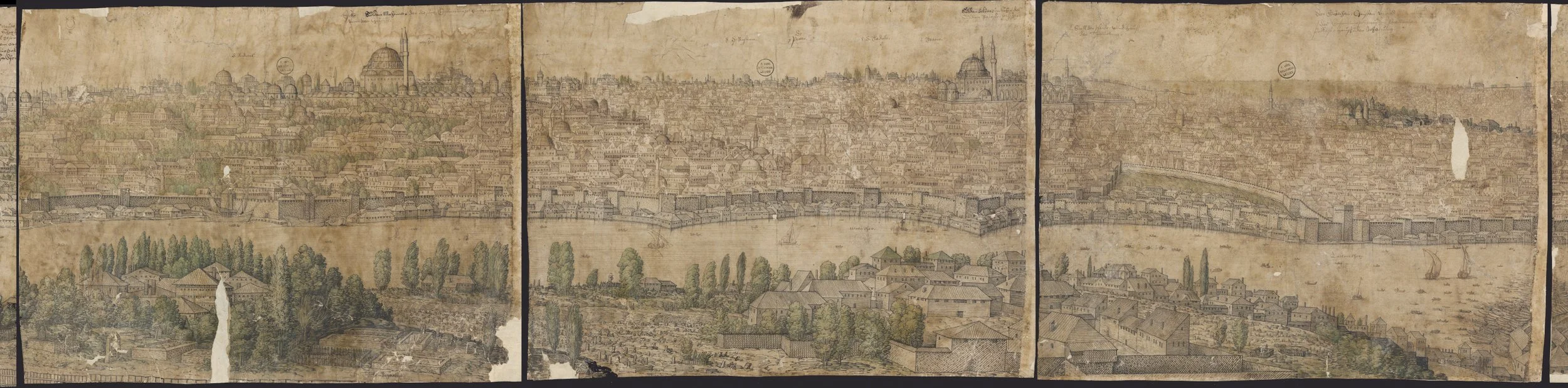
It’s worth noting that the prospect [an extensive view of a city or landscape, typically drawn from a high vantage point] is very large—it consists of 21 sheets of paper [and measures about 37 feet long by 18 inches high]. And Melchior Lorck depicts himself, seen from the back, in the middle of his vast representation of Constantinople. We may not notice the artist right away, but as we move closer, he contributes to how we interact with the city.
Lorck depicts himself in Pera, the European suburb, looking across the Golden Horn, the waterway in the foreground, at the ancient city of Constantinople. The location is practical since he could draw perspective views from different vantage points on the ramparts. It also afforded views of the city from a distance. Behind him was the Tower of Galata, constructed in the fourteenth century, with views of the extraordinary maritime topography that may have inspired the artist.
Even if the prospect benefits from maps and earlier city views, Lorck was trying to capture the whole thing. He depicts himself with pen in hand, his drawing board in front of him, insisting on his first-hand experience. This relationship between the self-portrait of the artist in the image and the city view we see from a distance makes us especially attentive to the artist’s intervention. He’s a kind of diplomat for us, describing what he thinks we should know.
On this point, a fascinating detail is the Ottoman assistant to his right. Two Ottoman men once flanked him, but these were chaperones overseeing him. Lorck was surely being shepherded around and needed their assistance to make the view. [Lorck had arrived as part of a diplomatic mission with the Habsburg ambassador, and the mission was confined for a year and a half over tensions around Hungary.] He was positioned between these two men, but the one on the left was removed, probably as a souvenir.
Lorck is standing with his back to viewers of the prospect, a vantage point that prompts us to look at the city. However, he isn’t looking at the city; his head is turned to the side instead. That’s an interesting gesture because it directs attention to the drawing of the city on the board in front of him. His outstretched arms also accentuate the size of his prospect. With his pen in his right hand, preparing to dip it in the inkwell, Lorck attests to being there, and to the truth of the image. His signature to the right, with the date 1559, furthers this claim.

I’m also interested in the cultural and political significance of the art piece. One thing I noticed in your writing was your remark about his clothing and what that says.
Yes, Lorck’s costume was something I noticed relatively recently in my research. His red cap and fancy sleeves are European, which seem at odds with the golden robe that has slipped off his shoulder. And then I realized that he’s making us aware of the disguise that he would have needed to wear to walk around the city. Foreigners were at risk of attack, especially artists. Traveling often required fitting in, and wearing clothes that allowed moving about without notice. Lorck accentuates his disguise by partially removing his Turkish robe and reminding viewers that he’s actually a European. Perhaps this gesture conveys something about his ambivalent relationship to the city and the embassy, given he was ordered to make the journey to Constantinople and then was incarcerated for months. The Turkish robes point to tensions arising from traveling with chaperones and to potentially being suspected of spying.
You finish your essay on the Prospect of Constantinople with a discussion of the edges and boundaries that are depicted in the illustration. I thought that was very interesting, especially because you seem to discuss many different types of boundaries in your analysis of the artwork: there are the cultural and geographical boundaries between the East and the West, and the physical boundaries between the objects. Could you tell me more?
I’ve been thinking about this work of art in terms of horizons of understanding. People who were traveling and making prospects of cities were encountering unfamiliar places, especially in Islamic dominions; they were trying to take in the whole and to delineate it on a drawing board, in a sketchbook, or on multiple pieces of paper. That process and those images reveal some of the possibilities for understanding other places and also the limits. Early modern prospects of cities are especially illuminating because artists were continually navigating between their vantage point and the horizon. Lorck aspired to depict Constantinople in all of its complexity, including its different waterways, to which the multiple sheets on which he drew its parts attest. Yet, at the same time, he was also confronting the limits of his own understanding, such as what he couldn’t see from his vantage point and his European perspective. Our horizons are tethered to the formats with which we work, the books that we read, the size of paper or screens that we use, and the limits of our own bodily understanding of the world through our senses.
This particular project of Lorck’s was intended for print, but it was probably too ambitious to be printed. [The original is made of pen and ink with touches of watercolor.] It would have been very expensive to print, given the size of copper plates or wood matrices, and costs of paper required for printing. The combination of the desire to know about the city and the ambitiousness of the project, together with its failure—the fact that it wasn’t printed—is particularly interesting. It helps us think about the possibilities and the limits of artistic representation, from the edges of the paper to categories for understanding phenomena. Sometimes limits become constraints, and it’s often pushing against those constraints where something new can emerge.
In my essay, one of the things I pitch is the importance of taking risks by moving outside the limits that constrain us to what we’re comfortable with. Of course there is a value in honing expertise and being an expert in one area. But sometimes that leads to constructing boundaries around that knowledge, even fortifications. Artworks themselves remind us of the benefits of attending to the edges of things, crossing boundaries, and grappling with what is unfamiliar in order to ask new questions rather than to reaffirm what we know.