-
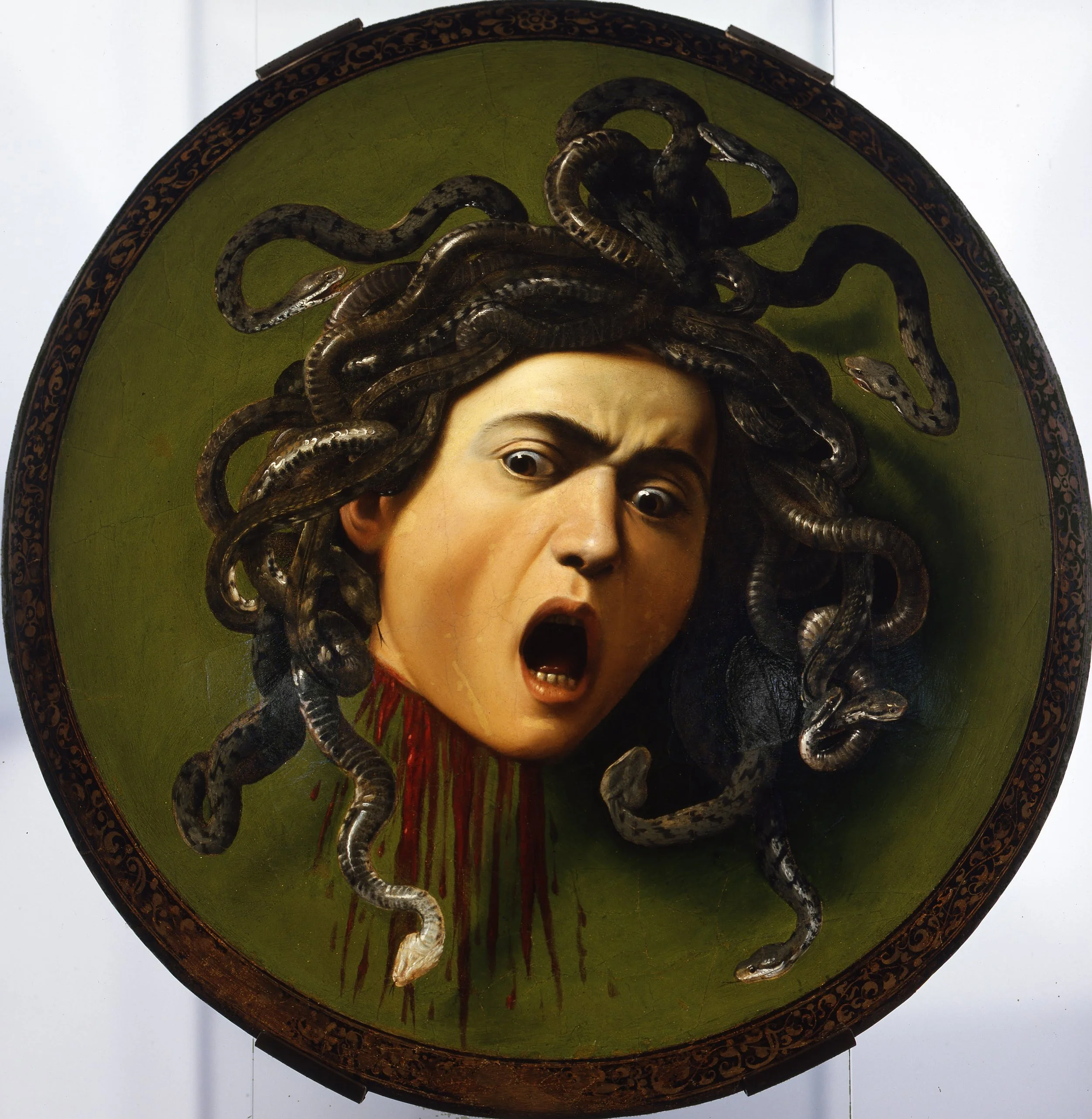
Caravaggio, Michelangelo. Medusa. 1597, Uffizi, Florence.
-
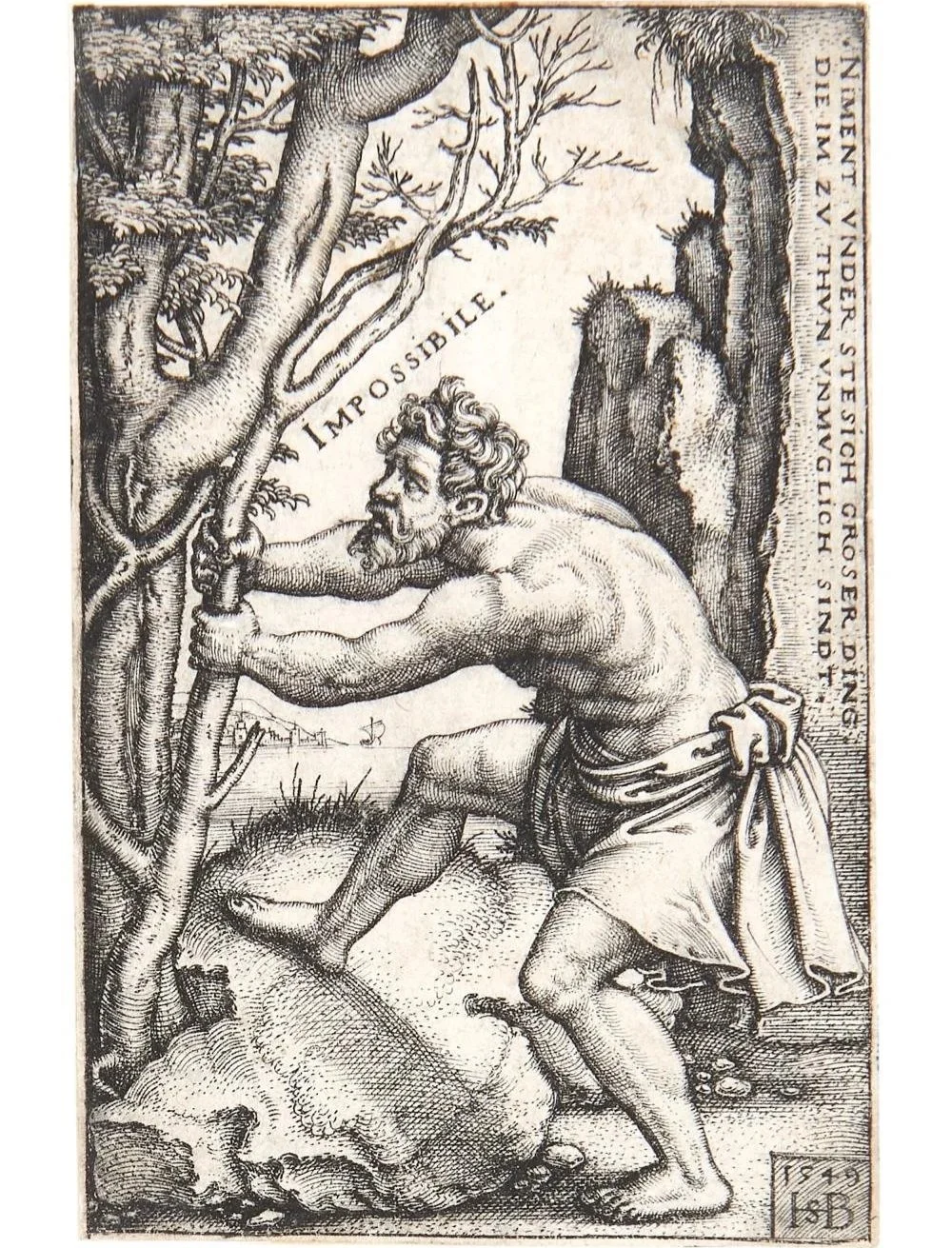
Beham, Sebald. Impossible. 1549, National Gallery of Art, Washington DC.
Can you tell me how it speaks to you?
It’s a really complex work of art, which is the first thing I like about it. I generally don’t like works of art that go down easily and don’t demand much. Caravaggio’s panel is a very demanding work of art. One of the things that has always fascinated me about it is the way it makes beauty and terror indistinguishable from one another. Medusa is a Gorgon (a mythological monster). The Gorgons were ravishingly beautiful women, yet Caravaggio has reinterpreted this. His Medusa is rather androgynous, and some have even thought that the face he used for the figure is a self-portrait, which is interesting in itself! Medusa herself is cursed with the horrible power of turning people to stone when they look at her. She’s meant to be so beautiful that looking at her transfixes us. The element of terror is that if we succumb to the temptation and look, then we’re literally turned to stone. We’re transfixed and frozen in place, and I think Caravaggio completely understood what that implied—what possibilities were opened up by making a picture that demands a certain kind of attention from a spectator. In my classes we always ask: what form of attention does a work like this demand?
The other thing that speaks to me is the fact that Caravaggio was one of those artists who was very self-aware of being in competition with others, of wanting to outdo his predecessors. There’s a famous legend (I say legend because we’re not sure if it actually happened) of Leonardo da Vinci wanting to create a Gorgon head that would produce an overwhelming sense of shock in whoever gazed upon it. We don’t have the work he actually produced, but we do have the series of stories about how he brought together snakes, toads, frogs, and all this gross stuff, created a terrarium of slithering creatures, and then tried to portray it on the surface of a convex wooden shield. Then he showed it to his dad, Piero, to see if he would be completely freaked out by it—and he was! Whether or not there ever was a Medusa shield actually painted by Leonardo doesn’t really matter. Caravaggio knew the legend, and he was trying to outdo the great Leonardo by creating a work that had the Gorgon’s terrifying face painted on a shield.
But he’s gone a step further and thought about what it means for the shield to be, not just a painted piece of wood, but another material entirely. He’s probably thinking about the legend of Perseus, and how Perseus finally slays Medusa, sneaking up on her and using his polished shield as a mirror to get his bearings. What I think is fascinating is the possibility that Caravaggio wanted to reproduce that moment where we catch a glimpse of Medusa in the shield. Perseus isn’t looking directly at her; he’s looking at the reflection. And so we, too, are seeing Medusa’s reflection in Perseus’s shield. But I think Caravaggio goes even further! I think he’s suggesting that what we see is not Medusa looking at us, but at her own reflection in the shield. And it’s right then, at that very moment of seeing, when Perseus severs her head and decapitates her.
So there are just several different layers of artifice and terror, all bound up together. And that is one of the things I think makes this an absolutely unique, world-class work of art.
I know you’ve written about representations of pain. Tell me how this specific art piece plays into that.
Yes. There’s pain in the picture. There’s Medusa’s pain at being a recently decapitated head without a body. And then there’s the pain of looking at that and finding, really, no way at all to identify with the character. This is a character who is just completely alien to us—completely other in every respect. And now even more so because she’s a head without a body. One of the things that connects this to some of my earlier work is that, in the long history of capital punishment, [and public performances of pain] there were myths circulating about the ability of a decapitated head to continue seeing and thinking and perceiving and even speaking! There are some really ghastly legends about Marie Antoinette. For example, when her head came off at the guillotine, she supposedly looked up, realized that she was dead, and said, “I am dead.” A lot of writers have been fascinated with that very paradoxical notion. How does a living being say “I am dead”? Is it just right on the cusp of death? That paradox is also part of Caravaggio’s painting.
Tell me about your chosen obscure work.
The person who made it was a German printmaker by the name of Sebald Beham, who lived in Nuremberg. He was born in the year 1500, and he was very close with the world-famous German Renaissance artist, Albrecht Dürer. One of the things that distinguishes his early career is that he came of age when the Protestant Reformation was breaking Catholicism apart. We don’t have any writings by Beham himself, but it’s pretty clear he was a hothead, and he was out in the streets denouncing Catholic priests, for example, and generally getting into trouble. In 1525, he was arrested along with several other painter-printmakers in the city and charged with heresy and espousing a form of radical Protestantism. To understand what’s going on, realize that there was the Martin Luther wing of the Reformation, which was the dominant one; but then there was also this dissident fringe of evangelical Christians who didn’t want to be Catholic anymore and also didn’t want to be Lutheran. They thought both confessions were repressive, and they were looking to other sources—more spiritual, more mystical sources—for their Christianity. Beham was arrested, and he could have been punished, possibly even sent to the gallows, but someone intervened on his behalf, so they only interrogated him, then expelled him from Nuremberg.
I was fascinated by the image of Beham as an artist who is also a self-styled dissident, someone who had real conviction about the need to transform Christianity. I’ve spent a lot of time tracing his career, starting with the early works that are combative and propagandistic.
This woodcut comes from much later in his career, when he settled down and realized he just needed to make some money. He was living in Frankfurt and doing his woodcuts and engravings for the publishing industry, and then he made this little woodcut called “Impossible.” I was really intrigued by the paradoxes that are built into it.
Along the side, there’s a poem that, as far as we can tell, is something that he wrote because it doesn’t appear in any other sources—a catchy little rhyme. The translation is basically: “Nobody should dare to do great things that are impossible for him to do.” I was really struck by how, on the one hand, there’s a simple moral interpretation: Don’t try to do things that you know are impossible, you’re just going to fall flat on your face. There’s also a paradox woven into it because, to try to do an impossible thing is possible, but only if you are a paradoxical being. So he starts that rhyme with the word Niment, which means nobody. It just so happens that the culture of his time had a number of different poems, legends, and ideas about a paradoxical fictional character named Nobody—Mr. Nobody.
This goes all the way back to Homer’s Odyssey, where Odysseus is in the cave of the Cyclops and he blinds the Cyclops. Then the Cyclops is asked by his fellow Cyclopses: “Who’s tormenting you?” And the guy says nobody, because Odysseus had tricked him in telling him his name was Nobody. It’s this paradoxical idea that Nobody can actually exist. And if anyone is going to try to do the impossible, it’s going to be Nobody. So nobody should try to do the impossible, but indeed, Nobody does try to do the impossible. Then you’ve got the image of this burly guy trying to pull a freshly grown tree out of the soil, which is really hard to do. So there he is, struggling against this tree. But there’s a suggestion that you’ve got to try anyway, you have to put yourself in the position of Nobody to attempt the impossible. I saw this as a reflection of the artist—his struggle with butting his head up against authority.
Could you tell me how you think the two works speak to each other?
Both of them get us tangled up in paradoxes, and both of them, I think, are works that demand our engagement—both our eyes and our minds. They demand that we become speculative viewers. It’s a term that I use a lot. Speculation is essentially taking the raw data of perception, what you see and experience in the visible world, simple or complex, and churning it over in your mind until you “see” the hidden principles that animate the world, whether that is the natural world or the social world of human interactions and institutions. To speculate is to see the world as if in a mirror (in Latin, a speculum), because the world of appearances is always in some sense reversed, and the speculating mind has to rearrange it, according to its own powers of reason, in order to get an accurate picture of what really is.
Can you tell me about yourself as an art historian? Where does your passion for art history stem from?
In general, I gravitate toward subjects where we don’t know a whole lot about the artist. What I like about studying Beham is that, although we have some biographical information and a lot of surviving prints by his hand, his character—as a person, as an artist, as a thinker, as a Christian spiritual being—is really still a mystery.
I gravitate toward those topics because, as an art historian, I really want to enjoy the freedom of interpretation that comes with not having an excess of documentation. I started as an artist and then shifted over to art history. I am better off not telling my colleagues this, but in general, I think of myself as an artist working with words and images rather than a scholar pursuing truth.
